Photonics and 3D Stacked Chips: The Next AI Wave
AI is evolving at an astonishing pace. Models are getting bigger, inference is happening in real time, and enterprises are deploying AI deeper into their infrastructure than ever before.
But here’s the uncomfortable truth: traditional silicon scaling isn’t enough anymore.
For decades, performance gains came from shrinking transistors. That roadmap is slowing down. The next leap in computing won’t come from simply making chips smaller, it will come from rethinking how they’re built.
Two major hardware shifts are now shaping the future of AI infrastructure:
- Photonic interconnects (using light instead of electricity)
- 3D stacked chip architectures
And industry leaders are betting billions on them.
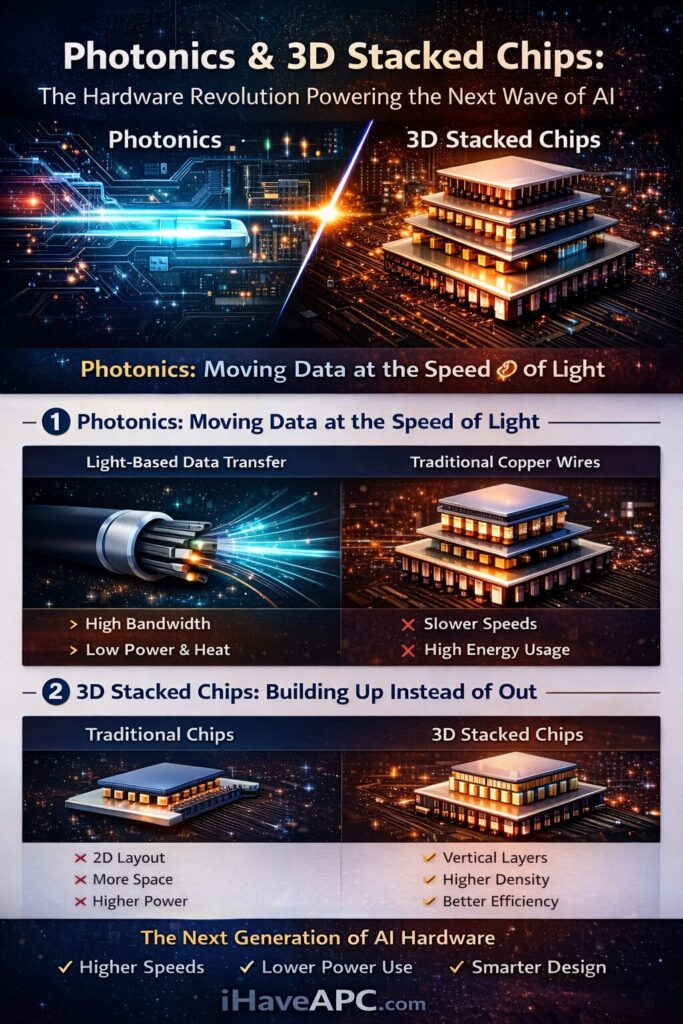
Photonics: Moving Data at the Speed of Light
One of the biggest bottlenecks in modern AI systems isn’t raw computation — it’s data movement.
Shuttling massive amounts of data between GPUs, CPUs, and memory consumes enormous power and generates heat. Traditional copper interconnects are reaching their limits.
That’s where Photonics comes in.
Instead of sending electrical signals through copper traces, photonic systems use light transmitted through optical components. This dramatically increases bandwidth while reducing heat and power consumption.
In early 2026, Nvidia announced a multibillion-dollar push into silicon photonics to enhance AI data center performance. The move signals a broader industry shift toward optical interconnects as AI workloads explode.
Why this matters:
- Light carries significantly more data than electrical signals.
- Optical systems reduce thermal constraints in dense AI clusters.
- Energy efficiency improves at scale — critical for hyperscale data centers.
You can read more about Nvidia’s photonics strategy here:
So Photonics is no longer experimental, it’s becoming foundational infrastructure for next-gen AI systems.
23D Stacked Chips: Building Up Instead of Out
The second major shift is architectural. Instead of laying chips flat across a motherboard, manufacturers are stacking silicon vertically. This is called 3D stacking and it’s transforming performance per watt.
Recently, Broadcom projected it expects to ship over a million 3D stacked AI chips in the coming years, underscoring how quickly this approach is moving into mainstream production.
More here.
So what makes 3D stacking powerful?
- Shorter communication paths between compute and memory
- Lower latency
- Better power efficiency
- Higher density in smaller form factors
It also allows chip designers to combine different manufacturing nodes in a single package. For example, advanced process nodes from TSMC can be integrated with specialized memory or logic layers to optimize both cost and performance.
Instead of relying purely on transistor shrinkage, 3D stacking improves how components interact which is exactly what AI workloads demand.
Why This Is Bigger Than Moore’s Law
For decades, the industry followed Moore’s Law: shrink transistors, double performance.
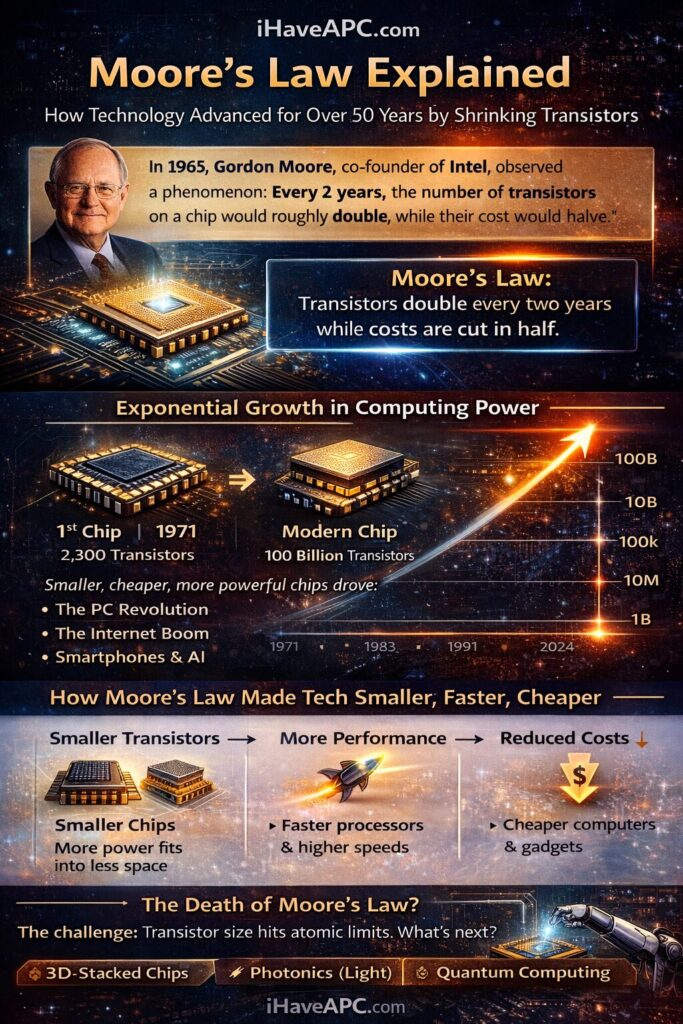
But we’ve entered a new era. The future of computing is becoming a system design problem rather than just a transistor problem.
AI models require:
- Massive bandwidth
- Efficient memory access
- Lower power consumption
- Faster interconnects
Photonics solves data movement. 3D stacking solves integration and efficiency.
Together, they redefine how AI infrastructure is built.
What This Means for Businesses and Enthusiasts
Over the next few years, we’ll likely see:
- AI data centers adopting hybrid electrical-optical fabrics
- Edge AI devices using 3D stacked chips for near-server performance
- More efficient enterprise AI deployments
- Reduced energy footprints for hyperscale infrastructure
For IT professionals, developers, and tech enthusiasts, understanding these hardware trends is critical. Software innovation may grab the headlines, but hardware architecture determines how far AI can scale.
And right now, that architecture is being reinvented.
The Bottom Line
We are witnessing the biggest hardware transition since the rise of GPUs.
- Light is replacing copper.
- Chips are stacking vertically.
- And AI infrastructure is evolving into something fundamentally new.
The next decade of computing won’t be defined by smaller transistors, it will be defined by smarter architecture.
So these are definitely exciting times. 🙂
Quickly View CPU And RAM Usage In Chrome

Send Files Securely Using Expiring Links Through Firefox Send
