Phone Friction-Maxxing: Why You Should Go Grayscale
We live in an attention economy, and currently, we are losing. Our smartphones, designed by some of the smartest minds on the planet, are optimized to capture and hold our gaze for as long as possible. They are vibrant, urgent, and deeply addictive.
If you’ve ever found yourself losing forty minutes to a “quick check” of Instagram, you know the struggle. Standard productivity advice tells you to use willpower. But willpower is a finite resource, and your phone’s algorithms are tireless.
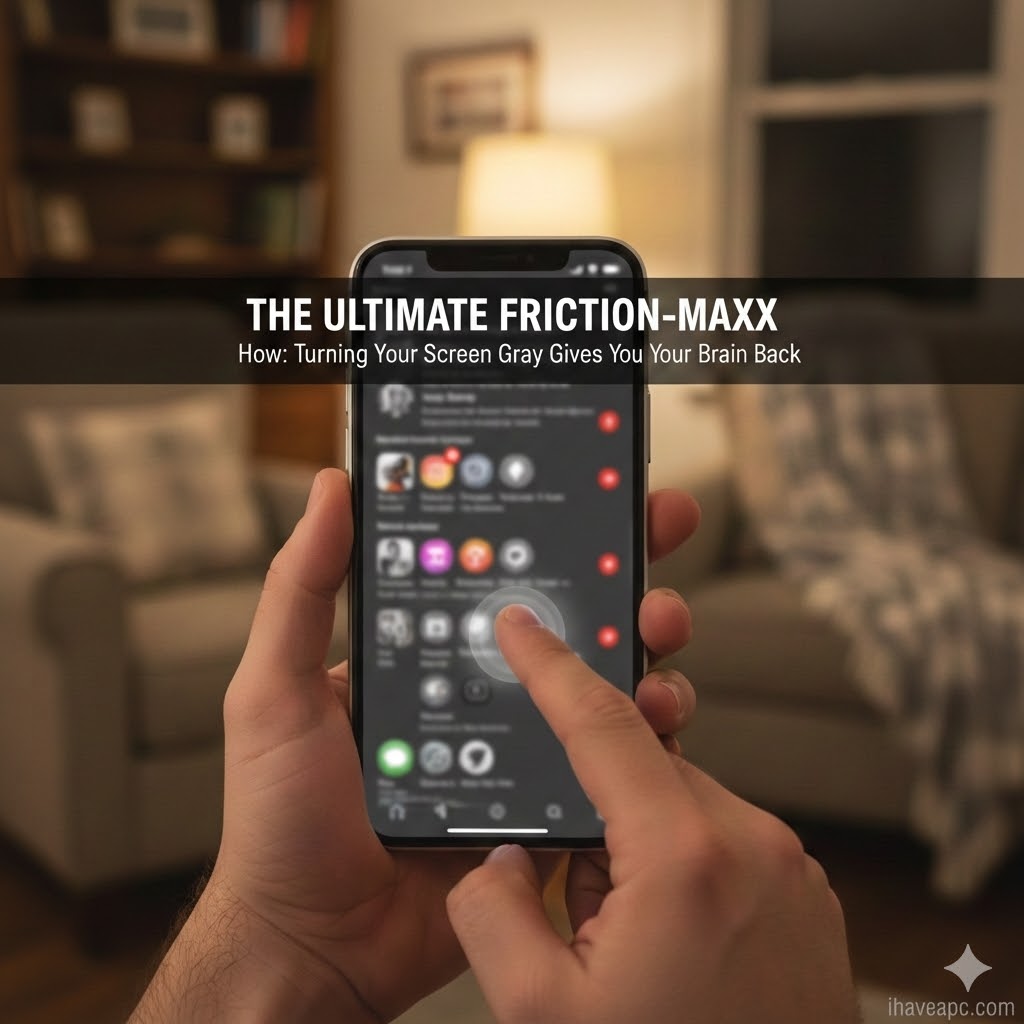
Enter a concept rising from the corners of internet self-improvement culture: Friction-Maxxing.
Friction-maxxing is the strategic antidote to modern convenience. Instead of trying to fight your impulses with sheer will, you redesign your environment to make bad habits as annoying, difficult, and “high-friction” as possible. You use your brain’s inherent laziness to your advantage.
And the single most effective, low-effort digital friction-max you can implement today? Turning your phone screen to grayscale.
Here is how sucking the color out of your display weaponizes friction against your phone addiction.
The Science: Why Your Phone is a Slot Machine
To understand why grayscale works, you have to understand what it’s combating. App developers leverage color psychology to trigger dopamine loops in your brain.
That bright red notification badge isn’t an accident; red is biologically wired to trigger alertness and urgency (think blood, fire, stop signs). The saturated blues of Facebook and the vibrant gradients of Instagram are “digital candy.” They offer your brain a micro-reward every time you unlock your screen. Your brain learns that a colorful glowing rectangle = good feelings.
Grayscale mode breaks this loop. It is the digital equivalent of replacing the candy in your pantry with raw broccoli.
How Grayscale “Maxes the Friction”
When you switch your phone to black and white, you aren’t physically stopping yourself from opening an app. You can still do everything you used to do. But you have added significant mental friction to the experience.
Here are three ways this friction changes your behavior:
1. The “Boredom Barrier”
The primary friction introduced by grayscale is boredom. Without the stimulation of vivid colors, your brain’s visual interest wanes rapidly.
In full color, an Instagram feed is a dopamine-rich environment of sunsets, food photos, and vibrant outfits. In grayscale, it looks like a dusty newspaper. A colorful mobile game feels like a Vegas casino; a grayscale mobile game feels like filling out a spreadsheet.
By removing the visual reward, you increase the mental effort required to stay engaged. Your brain, seeking the path of least resistance, will sooner realize, “This isn’t actually fun right now,” prompting you to put the phone down.
2. Neutralizing the “Red Dot” Urgency
The most pernicious element of phone design is the red notification bubble. It is a visual shout designed to create a subtle sense of anxiety until you click it away.
In grayscale, that screaming red dot becomes a dull gray circle.
This is a massive friction point for impulsive checking. By stripping the color, you strip the artificial urgency. The notification goes from being a “threat” that demands immediate action to a simple piece of data that you can deal with on your own time. You no longer feel a visceral pull to “clear the board.”
3. Breaking the Zombie Scroll Trance
We often fall into “zombie scrolling” because the constant variation of color provides just enough novelty to keep our eyes moving down the screen. It’s a hypnotic state where you aren’t really consuming content; you are just being visually stimulated.
Grayscale acts as a friction brake on this process. Without color variation to hook your eye, the infinite scroll becomes visually monotonous very quickly. The friction of trying to parse bland, gray images snaps you out of the trance and returns executive function to your prefrontal cortex, allowing you to decide to stop.
From Toy to Tool
The ultimate goal of friction-maxxing your phone isn’t to become a Luddite and smash your device. It’s to change your relationship with it.
A full-color phone is a toy, an entertainment center, and a dopamine dispenser. A grayscale phone is a tool. It is perfectly functional for maps, calls, emails, and reading articles, but it is terrible for mindless entertainment.
By introducing the friction of a boring aesthetic, you ensure that when you pick up your phone, it’s because you have a specific intention—not because your brain is craving a hit of digital sugar.
The Tactical Move (How to Try It)
You don’t have to commit to a life of monochrome immediately. The best way to use this friction-max is to set it up as a toggle.
On both iPhones (under Accessibility > Display & Text Size > Color Filters) and most Androids (under Digital Wellbeing or Accessibility settings), you can set a shortcut to turn grayscale on and off with a triple-click of the side button.
Try “friction-maxxing” your evenings. At 8:00 PM, triple-click into grayscale mode.
Watch how much easier it becomes to ignore the glowing rectangle and re-engage with the real world.
Do give it a try.

The Return of the Dial: Why “Dumbphones” Are the Smartest Move

How White Noise Can Supercharge Your Focus and Digital Wellbeing