Why Offline Work is Deep Work
We live in an era where being “disconnected” is often framed as a technical failure. We panic when the Wi-Fi bars drop, yet for anyone trying to build something from nothing—be it a novel, a complex codebase, or a brand strategy—that “failure” might actually be the greatest productivity hack available.
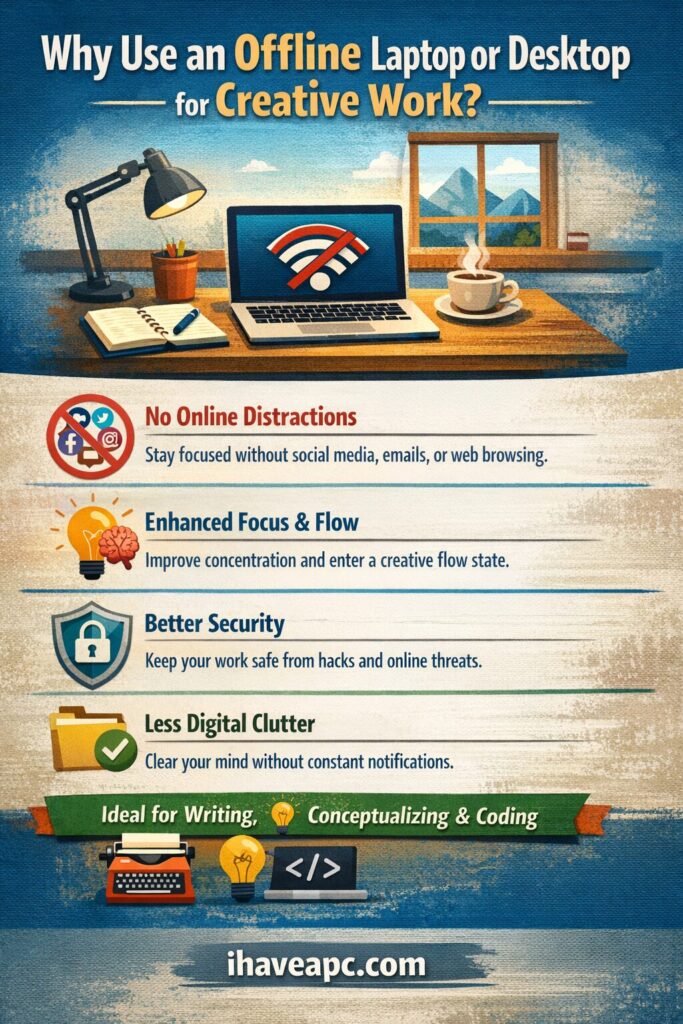
Using an offline laptop or desktop isn’t about being a Luddite; it’s about creating a digital sanctuary. It transforms your computer from a portal to the entire world back into what it was originally meant to be: a focused tool for creation.
The Myth of the “Quick Search”
We’ve all been there. You’re writing a scene and need to know what kind of trees grow in Oregon. You open a tab to check, and forty minutes later, you’re reading the Wikipedia entry for the 1994 Winter Olympics.
When you work offline, you’re forced to bypass the “research trap.” Instead of breaking your rhythm to find a fact, you leave a placeholder like [RESEARCH LATER] and keep the creative momentum moving. This is vital because, as research on task switching shows, it can take our brains significantly longer to get back into the “zone” after even a brief interruption.
Protecting the Flow State
Creative work especially coding requires “Deep Work,” a term coined by author Cal Newport. To solve a complex bug or architect a system, you need to hold a massive amount of information in your working memory.
Every Slack ping, email notification, or news alert acts as a “cognitive tax.” Even if you don’t click the notification, your brain acknowledges it, causing what psychologist Sophie Leroy calls “attention residue.” Offline machines provide a zero-noise environment where your focus can expand to fill the space available.
Building Mental Muscle
In the coding world, the internet is often a crutch. If a function doesn’t work, the instinct is to hit Stack Overflow immediately. While efficient for tasks, it’s detrimental to learning.
When you’re offline, you’re forced to actually read your own logic and walk through the code line-by-line. This “first principles” thinking builds much stronger mental pathways. You aren’t just copy-pasting a solution; you’re inventing one. For developers, tools like Dash or Zeal allow you to keep API documentation offline, ensuring you have the “dictionary” without the distractions of the “library.”
Reclaiming Your Voice
The internet is high-entropy. It is a cacophony of other people’s opinions, styles, and successes. It is very hard to find your own creative voice when you are constantly bombarded by everyone else’s.
By cutting the cord, you lower the “noise floor” of your life. An offline desktop offers a rare, quiet room where the only thoughts present are your own. It turns the act of creation from a reactive process into a proactive one.
In a world that demands we always be “on,” the most radical and productive thing you can do for your craft is to occasionally turn everything off.

The Return of the Dial: Why “Dumbphones” Are the Smartest Move

The Hidden Traps in Your Social Media Feed