The Rise of “Quiet Tech”: Why Subscribing to Fewer Apps is the New Luxury
There was a time when getting a new PC meant installing software you actually owned. You bought a disc, typed in a product key, and that software lived on your hard drive until the end of time. It didn’t ask for your credit card every thirty days, it didn’t gatekeep dark mode behind a premium tier, and it certainly didn’t send you a passive-aggressive email because you hadn’t logged in all week.
Fast forward to today, and the digital landscape looks vastly different. We are living in the peak era of subscription fatigue. From weather apps and text editors to calendar tools and basic file converters, everything has been repackaged into Software-as-a-Service (SaaS).
But a quiet counter-movement is brewing. Tech users are pushing back against the endless cycle of micro-leases, trading flashy cloud features for something far more valuable: peace of mind.
Welcome to the era of Quiet Tech where the ultimate digital luxury isn’t having an app for everything, but having a clean, silent, paid-in-full digital environment.
The Micro-Anxiety of the “Rent-Seeking” Internet
When software companies shifted to subscription models, they pitched it as a win for consumers: lower upfront costs and continuous updates. But by 2026, that dream has soured into what tech critics call the “rent-seeking” internet.
The issue isn’t just financial, though death by a thousand $4.99 cuts is a real threat to your bank account. The real tax is cognitive.
Every active subscription on your computer creates a subtle, subconscious open loop. When you pay monthly for a premium productivity tool, a habit tracker, or a design app, you feel a lingering sense of guilt if you aren’t using it daily.
Suddenly, your tools are no longer serving you; you are serving your tools to “get your money’s worth.”
Quiet Tech is the decision to close those loops.
What Exactly is “Quiet Tech”?
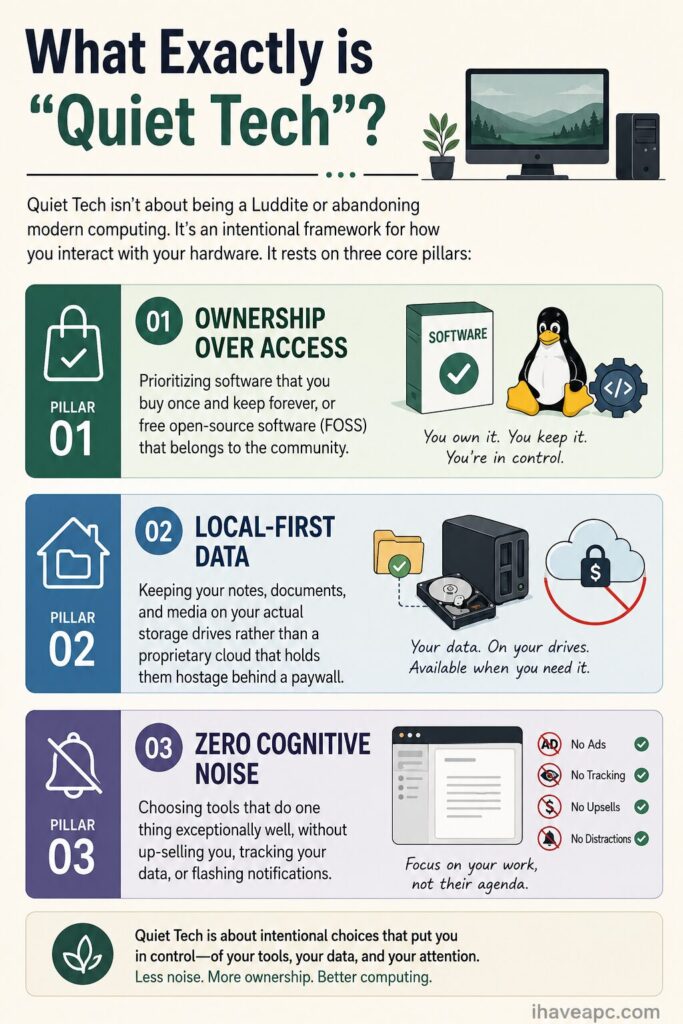
Quiet Tech isn’t about being a Luddite or abandoning modern computing. It’s an intentional framework for how you interact with your hardware. It rests on three core pillars:
- Ownership Over Access: Prioritizing software that you buy once and keep forever, or free open-source software (FOSS) that belongs to the community.
- Local-First Data: Keeping your notes, documents, and media on your actual storage drives rather than a proprietary cloud that holds them hostage behind a paywall.
- Zero Cognitive Noise: Choosing tools that do one thing exceptionally well, without up-selling you, tracking your data, or flashing notifications.
The Swap List: Reclaiming Your Digital Space
If you’re ready to quiet down your PC, you don’t have to sacrifice functionality. High-quality, one-time-purchase or open-source alternatives are thriving right now.
| Instead of Renting… | Switch to the “Quiet Tech” Alternative | Why It’s a Better Experience |
| Notion / Evernote (Up to $15/month) | Obsidian or Logseq | They use local Markdown files stored directly on your hard drive. They are lightning-fast, work completely offline, and will still open 20 years from now. |
| Adobe Lightroom / Photoshop ($10–$20/month) | Affinity Photo 2 or darktable | Affinity offers a traditional “buy-it-once” perpetual license. darktable is entirely free, open-source, and incredibly powerful for raw photo editing. |
| Premium To-Do & Calendar Apps ($5/month) | Native OS Apps (Windows Reminders / Apple Notes) | Standard stock apps have become remarkably robust. They are pre-installed, highly optimized, and won’t try to sell you an AI upgrade to organize your grocery list. |
| Cloud Storage Upgrades ($3–$10/month) | A Local External SSD | A physical, high-speed 2TB external drive is a one-time investment that pays for itself in less than a year compared to perpetual cloud tiers. |
How to Conduct a Subscription Audit This Weekend
Reclaiming your digital peace doesn’t require a radical overhaul. You can start turning down the noise with a simple three-step audit.
1. Run the 21-Day Cold Cut
Take a look at your bank statements from the last three months and list every recurring software charge. If there is an app you haven’t opened in the last three weeks, cancel it immediately. If you truly need it later, the company will happily take your money again. But more often than not, you’ll completely forget the app even existed.
2. Embrace the “Good Enough” Native Tool
Before downloading a third-party application to solve a problem, look at what your operating system can already do. Modern Windows and macOS utilities are cleaner and more capable than they’ve ever been. A basic text file in Notepad or a quick entry in a stock calendar app is often all you actually need minus the tracking cookies.
3. Hunt for the One-Time Purchase Unicorns
When you do need premium software, actively look for developers who still respect the traditional ownership model. Many independent developers offer “lifetime licenses” or a “pay for this version, keep it forever” model. Supporting these creators sends a direct signal to the market that users value ownership.
The Ultimate Digital Flex
True luxury isn’t about automation, cloud synchronization, or having an AI agent constantly optimizing your calendar. True luxury is control.
When you boot up a PC built on Quiet Tech principles, you are stepping into a workspace that you own entirely. There is a profound sense of freedom that comes with opening your laptop, doing your work in absolute peace, and knowing that nobody is charging your credit card while you sleep.
The Return of the Dial: Why “Dumbphones” Are the Smartest Move
The Hidden Traps in Your Social Media Feed