Pen, Paper, or Pixels? The Secret to Better Digital Wellbeing
It’s 11:00 PM. The glow of your laptop screen is illuminating your face, your eyes feel like they’re filled with sand, and you have 14 tabs open. You are “working,” but your brain feels like a browser that’s about to crash.
We’ve all been there. We live our lives through screens. We type out our thoughts, swipe through our schedules, and tap out our to-do lists. But lately, a quiet rebellion is taking place. People are buying beautiful journals, investing in nice pens, and returning to the analog world.
It begs the question: In an era where digital efficiency is king, why does a blank piece of paper feel like a breath of fresh air? And more importantly which medium is actually healthier for us?
When we view this debate through the lens of digital wellbeing—the practice of building a healthy relationship with technology—the battle between paper and pixels isn’t just about nostalgia. It is about our cognitive health, our physical bodies, and our ability to simply disconnect.
Here is how the two stack up, and how you can use both to design a healthier life.
The Brain on Paper: A Cognitive Superpower
When it comes to your mental health and cognitive processing, paper doesn’t just win; it dominates.
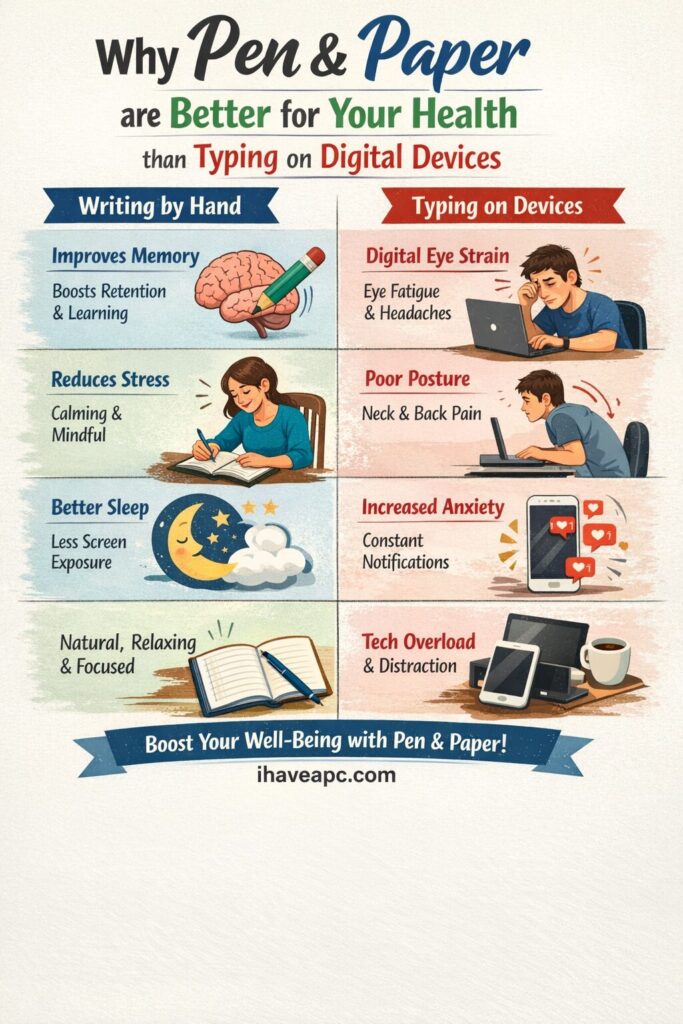
Writing on a screen often traps us in a cycle of shallow processing. Because most of us can type significantly faster than we can write, we tend to transcribe information mindlessly, word-for-word. Add the constant barrage of pop-up notifications, unread emails, and the temptation to switch tabs, and our brains are locked in a state of high cognitive load and baseline stress.
Paper, on the other hand, is the ultimate single-tasking medium. It demands your full, undivided attention. But the benefits go much deeper than just avoiding distractions. Science shows that the physical act of writing changes how our brains work:
- It forces deeper understanding: A famous study from Princeton and UCLA (“The Pen is Mightier Than the Keyboard”) found that students who took notes by hand on paper outperformed those who typed on laptops when answering conceptual questions. Because writing is slow, your brain is forced to summarize and synthesize the information in real-time.
- It supercharges brain connectivity: Recent high-density EEG research from the Norwegian University of Science and Technology (NTNU) revealed that writing by hand creates widespread connectivity across the brain’s networks. The intricate motor movements required to form letters establish neural pathways that are crucial for memory formation—pathways that simply typing on a keyboard doesn’t activate.
- It anchors your memory: A study by neuroscientists at the University of Tokyo found that writing on physical paper leads to significantly stronger brain activity in the hippocampus (the brain’s memory center) compared to writing on a tablet or smartphone. Researchers concluded that the complex spatial and tactile cues of a physical notebook feeling the paper, remembering where a note was on the page, the physical permanence of the ink make information much easier to recall.
Furthermore, journaling on paper is a profoundly grounding exercise. Therapists frequently recommend analog journaling because it slows down racing thoughts and relieves anxiety without the stimulating glare of a screen.
The Physical Toll: Eyes, Posture, and Sleep
Digital wellbeing isn’t just about what’s happening in your mind; it’s about how your tools treat your body.
The Screen Tax: Staring at backlit devices comes with a hefty physical cost. When we look at screens, our blink rate drops by up to half, leading to Digital Eye Strain (dry eyes, blurred vision, and tension headaches). Furthermore, the blue light emitted by our devices suppresses melatonin production. Typing out your thoughts late at night tricks your brain into thinking the sun is still up, severely disrupting your sleep cycle.
However, screens do have one major physical advantage: Ergonomics. If you are typing a 10-page report, a proper desk setup with your monitor at eye level, a supportive chair, and a good keyboard is vastly superior for your posture and wrists than hunching over a notebook.
The Paper Advantage: Paper emits zero blue light. Your eyes blink normally, and reading or writing on a physical page before bed acts as a natural wind-down routine, signaling to your body that it is time to rest. The only physical drawback to paper? “Text neck” from hunching over your desk and the dreaded hand cramp from gripping a pen for too long.
The Verdict: Designing Your Digital Diet
True digital wellbeing doesn’t mean throwing your laptop out the window and moving to a cabin in the woods. It means matching the tool to the task so you can protect your peace, your eyes, and your mind.
You can get the best of both worlds by creating boundaries:
Reach for Paper When:
- You need to brainstorm or be creative. Let the physical bounds of the page free your mind from the distraction of the internet.
- You are learning something new. Take notes by hand to force your brain to synthesize the material.
- It’s the last hour of the day. Swap the doom-scrolling for a notebook. Write down your worries, your to-do list for tomorrow, or what you are grateful for, and let your eyes rest.
Reach for Screens When:
- You are executing long-form work. Use your ergonomic desk setup to type fast, edit, and organize large amounts of data without destroying your hands or your back. Just remember the 20-20-20 rule to save your eyes: every 20 minutes, look at something 20 feet away for 20 seconds.
We live in a beautiful, hyper-connected world, but our brains were not designed to process a million pixels a second. Sometimes, the healthiest thing you can do for your digital wellbeing is to close the laptop, pick up a pen, and remember what it feels like to just be human.
Which is Better: Digital vs. Offline Journaling

The Hidden Traps in Your Social Media Feed