Which is Better: Digital vs. Offline Journaling
Journaling is widely recognized as one of the most accessible and effective tools for organizing thoughts, managing anxiety, and practicing self-assessment. By transferring our internal monologue onto a page or screen, we create space to process complex emotions.
But as technology integrates deeper into our daily lives, a practical dilemma arises: should you stick to the romanticized, old-school method of pen and paper, or embrace the convenience and searchability of an online journal?
Both mediums serve the fundamental purpose of reflection, but they interact with our brains in profoundly different ways. Here is a breakdown of the pros, cons, and psychological impacts of digital versus traditional journaling.
Old-School Offline Journaling (Pen and Diary)
For centuries, putting a pen to parchment has been the primary way humans record their inner lives. Writing by hand is a sensory, physical experience.

The Pros
- Zero Distractions: A physical notebook has no notifications, no open tabs, and no battery life to worry about. It offers a forced disconnection from the digital noise.
- Total Privacy: Unless someone physically finds and reads your book, your thoughts are entirely immune to data breaches, cloud syncing errors, or server hacks.
- Tactile Satisfaction: Many find the physical act of uncapping a pen and feeling the texture of the paper to be a calming, grounding ritual.
The Cons
- Vulnerability to Loss: A physical diary can be misplaced, destroyed in a fire, or ruined by a spilled cup of coffee.
- Lack of Searchability: Finding a specific thought, pattern, or entry from months ago requires manually flipping through pages.
- Physical Limitations: Hand cramps are real, and keeping a physical book on your person at all times isn’t always practical.
Cognitive & Mental Well-being Impact
The primary advantage of analog journaling lies in neuroscience. Because humans write by hand much slower than they type (roughly 0.33 words per second versus 0.67 words per second), handwriting acts as a “beneficial bottleneck.” You cannot transcribe your thoughts verbatim; you are forced to synthesize, summarize, and reflect in real-time.
Research highlighted by National Geographic shows that writing by hand activates a much broader network of brain regions involved in motor, sensory, and cognitive processing compared to typing. This multisensory engagement fosters deeper emotional processing and better memory encoding. For mental health, the slow pace of a pen forces you to sit with your feelings rather than just rushing past them.
Digital and Online Journaling (Apps and Cloud)
Whether it’s a dedicated app, a simple Google Docs, or voice memos, digital journaling is built for the speed of modern life.
The Pros
- Unmatched Accessibility: Your journal syncs across your phone, tablet, and laptop. You can jot down a thought the moment it strikes, whether you are on a train or waiting in line.
- Searchability and Analytics: Digital journals act as a pattern-recognition engine. You can search by keywords, tags, or dates to instantly track how your mood or specific anxieties have evolved over time.
- Multimedia Integration: You aren’t limited to words. You can easily attach photos, voice notes, and links that capture the context of your day.
The Cons
- The Distraction Tax: Writing on the same device you use for social media, email, and news requires immense discipline. A single notification can pull you out of a moment of deep reflection.
- The “Edit” Button: Digital text lacks permanence. The ability to backspace and edit your entries can lead to over-sanitizing your feelings, reducing the raw honesty that makes journaling effective.
- Screen Fatigue: For those who already spend eight hours a day staring at monitors, digital journaling can feel like an extension of work rather than a retreat.
Cognitive & Mental Well-being Impact
While digital journaling may not trigger the same deep neural pathways as handwriting, it is incredibly effective for release. According to WebMD, studies show that typing online for just 15 minutes a few days a week can significantly reduce depressive symptoms and anxiety.
Digital tools are perfect for “brain dumping” which is rapidly offloading racing, anxious thoughts faster than a pen could ever keep up. However, neuroscience reviews note that typing generally results in more passive cognitive engagement.
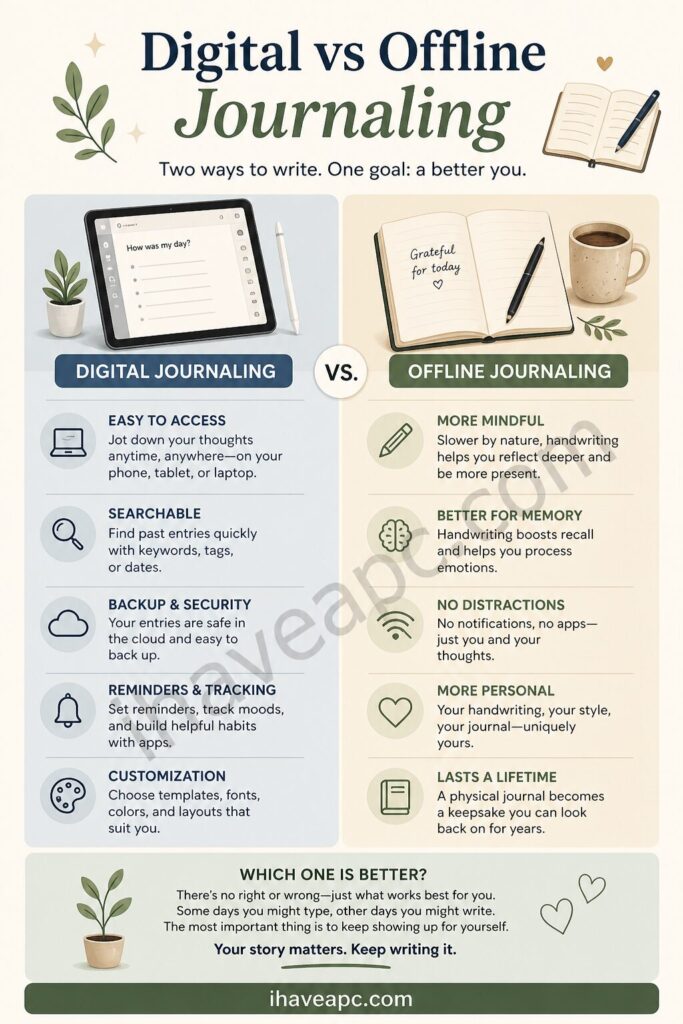
It is excellent for logging volume and achieving consistency, but it may not always facilitate the deep, paradigm-shifting realizations that come from slower, deliberate handwriting.
At a Glance: Digital vs. Analog Journaling
| Feature | Pen & Paper | Digital / Online |
| Speed | Slow (Encourages deep reflection) | Fast (Great for rapid brain-dumps) |
| Brain Engagement | High (Activates multiple neural pathways) | Moderate (More passive cognitive engagement) |
| Searchability | Low (Manual review required) | High (Instant keyword searching and tagging) |
| Convenience | Moderate (Requires carrying physical items) | High (Always accessible via smartphone/cloud) |
| Distraction Level | Zero | High (Requires managing notifications) |
The Verdict
The real question isn’t which tool is objectively superior; it is which tool reduces the friction enough for you to actually use it.
If your mind is loud, racing, and you need to slow down and process complex emotions, reach for a pen and paper. The tactile friction will ground you.
If your life is incredibly busy, you want to track behavioral patterns over years, and you know you won’t consistently carry a notebook, go digital.
For many, a hybrid approach works best: using a notes app to quickly capture thoughts and triggers on the go, while keeping a physical notebook on the nightstand for deep, distraction-free emotional processing at the end of the day.
Happy journaling.

The Wired Earphone Comeback: Why It’s Better for Your Digital Wellbeing
The Return of the Dial: Why “Dumbphones” Are the Smartest Move