The Art of the “Mindful Binge”in the Streaming Era
It starts innocently enough. You’ve had a long week, you sink into the couch, and you hit play on that new series everyone is talking about. But then, the credits roll, and before you can even reach for the remote, a small countdown timer begins. Five… four… three…
Suddenly, it’s 2:00 AM. You’re six episodes deep, your eyes are dry, and you have that vague, heavy feeling of “what just happened to my evening?”
If this sounds familiar, you are certainly not alone. With the availability of high-quality streaming services like Netflix, Hulu, and Disney+, “binge-watching” has transformed from a rare indulgence into a standard nightly ritual. While stories are a beautiful part of the human experience, the way we consume them has shifted.
The goal of digital wellness isn’t to stop watching TV, it’s to put you back in the driver’s seat. This guide will walk you through practical, human-centric tips to enjoy your favorite content without losing track of your life.
1. Understand the “Hook”: Why We Can’t Look Away
To manage your time, it helps to understand what you are up against. Streaming platforms are not just libraries of content; they are sophisticated engines designed to keep you engaged.
When you watch a show you enjoy, your brain releases dopamine: a chemical associated with pleasure and reward. It feels good, so your brain naturally wants more. Streaming services amplify this by removing “friction.” They auto-skip intros, auto-play the next episode, and use “cliffhangers” (unresolved plot points) to trigger your curiosity.
This creates a “flow state” where you lose track of time. It’s not a lack of willpower; it’s a design feature. Recognizing this is the first step to beating it. You aren’t fighting against yourself; you are fighting against an algorithm.
2. The Technical Toolkit: Friction is Your Friend
The easiest way to break a habit is to change your environment. In the digital world, this means re-introducing the “friction” that streaming services have removed.
Turn Off Autoplay (The Golden Rule)
This is the single most effective change you can make. The “Autoplay” feature is the default on almost every platform, and it makes the decision to continue watching automatic rather than intentional.
- The Fix: Go into your account settings (usually under “Playback Settings” or “Profile”) and toggle “Autoplay Next Episode” to OFF.
- The Result: When an episode ends, the screen stops. You are forced to pick up the remote and physically click “Play” if you want to continue. That tiny, 3-second pause breaks the trance and gives your rational brain a chance to ask: “Do I actually want to watch another one, or do I need to sleep?”
Use “Sleep Timers” on Your TV
If you are prone to falling asleep with the TV on or losing track of hours, let your hardware help you. Most modern smart TVs have a built-in sleep timer.
- The Strategy: Set the timer for 60 or 90 minutes before you start watching. When the TV turns off, it serves as a hard “reality check.”
Digital Wellbeing Apps
If you watch primarily on a tablet or phone, use the built-in digital wellbeing tools.
- Android: Use the Digital Wellbeing dashboard to set a daily timer for your streaming apps. When your time is up, the app pauses.
- iOS: Use “Screen Time” to set “App Limits” for entertainment categories.
3. The “Cliffhanger” Hack: Rewire How You Watch
We binge because we need to know what happens next. Writers know this, which is why almost every episode ends with a shocking reveal or a character in peril. This makes it agonizing to stop.
The Solution: Stop watching in the middle of an episode.
It sounds counterintuitive, but it works wonders. Here is the strategy:
- Watch the end of Episode 1. The big twist happens!
- Immediately start Episode 2.
- Watch the first 10-15 minutes of Episode 2. The cliffhanger from the previous episode is usually resolved, and the characters settle into the new plotline.
- Pause and turn it off.
By stopping during the “lull” of the narrative arc (usually the middle of an episode), you satisfy your curiosity about the cliffhanger, but you aren’t yet hooked on the next twist. It is much easier to walk away when the characters are just eating lunch or discussing a plan than when they are hanging off a literal cliff.
4. Mindful Viewing: Quality Over Quantity
Mindfulness is simply the act of paying attention. Often, we binge-watch not because we are enjoying the show, but because we are “zoning out.” This is sometimes called “purge-watching”—consuming content just to kill time, without actually savoring it.
The “Savoring” Technique
Treat a TV show like a rich dessert. If you eat the whole cake in five minutes, you feel sick. If you eat one slice slowly, it’s a delight.
- Single-Tasking: When you watch, just watch. Put your phone in another room. If you are scrolling through social media while the show is playing, your brain isn’t getting the full satisfaction of either activity, leaving you feeling restless and prone to watching “just one more” to feel satisfied.
- Review It: After an episode, take 60 seconds to think about what you just saw. What was the best line of dialogue? How was the lighting? This tiny act of critical thinking moves your brain from “passive consumption” to “active engagement,” making it easier to stop.
The “One Episode Per Night” Ritual
Try to return to the old-school model of appointment viewing. Make an agreement with your household (or yourself) that you will watch only one episode per night, perhaps at a specific time (e.g., 8:00 PM). This builds anticipation. The wait between episodes actually increases your enjoyment of the story because you have time to theorize and wonder what will happen next.
According to Scripps Health, setting these specific time limits and replacing screen time with other activities is vital for reducing dependency.
Binge-watching is sedentary by nature, which can lead to lethargy. The more lethargic you feel, the harder it is to get off the couch. You can disrupt this cycle with physical triggers.
The “Standing Ovation” Rule
Make a rule: You must stand up between episodes.
Even if you plan to watch three episodes in a row, force yourself to stand up, stretch, or walk to the kitchen between them. This resets your blood flow and wakes up your body. It reminds you that you exist in the physical world, not just the digital one.
The 20-20-20 Rule
Eye strain is a major side effect of binging. To combat this, experts recommend the 20-20-20 rule: Every 20 minutes, look at something 20 feet away for at least 20 seconds. This simple habit protects your vision and breaks the hypnotic stare that screens often induce.
6. Curate Your Environment
Your physical surroundings dictate your digital behavior. If your living room is designed solely for passive consumption, that is what you will do.
The “Dark Room” Trap
Movie theaters are dark to focus your attention solely on the screen. To avoid getting sucked in at home, keep the lights on. watching in a fully lit room reminds your brain that it is still daytime (or evening) and keeps you aware of your surroundings (like that pile of laundry or the clock on the wall).
Create “No-Screen” Zones
Designate specific areas of your home where screens are forbidden.
- The Bedroom: Keeping TVs and tablets out of the bedroom is one of the best things you can do for your sleep hygiene. The blue light from screens interferes with melatonin production, and the mental stimulation of a plot-heavy show keeps your brain alert.
- The Dinner Table: Reclaim meals as a time for conversation or mindful eating, rather than consumption.
7. What to Do Instead? (The Replacement Theory)
Often, we binge-watch because we don’t have a plan for what else to do. It’s the path of least resistance. To break the habit, you need attractive alternatives ready to go.
- The “Active Rest” List: Write down three things you can do that are relaxing but don’t involve screens. Examples:
- Reading a physical book or graphic novel.
- Listening to a podcast while taking a short walk.
- Doing a puzzle or LEGO set.
- Journaling or sketching.
- Socialize: Instead of watching alone, organize a watch party with friends. Discussing the show makes it a social event rather than an isolation tank. When the discussion ends, the viewing usually does too.
Experts at Game Quitters suggest that identifying the root cause of your binging (boredom, stress, escapism) helps you choose the right replacement activity. If you are stressed, you might need yoga or a hot bath. If you are bored, you might need a creative hobby.
Summary Checklist for Tonight
Ready to try it? Here is your quick-start guide for your next viewing session:
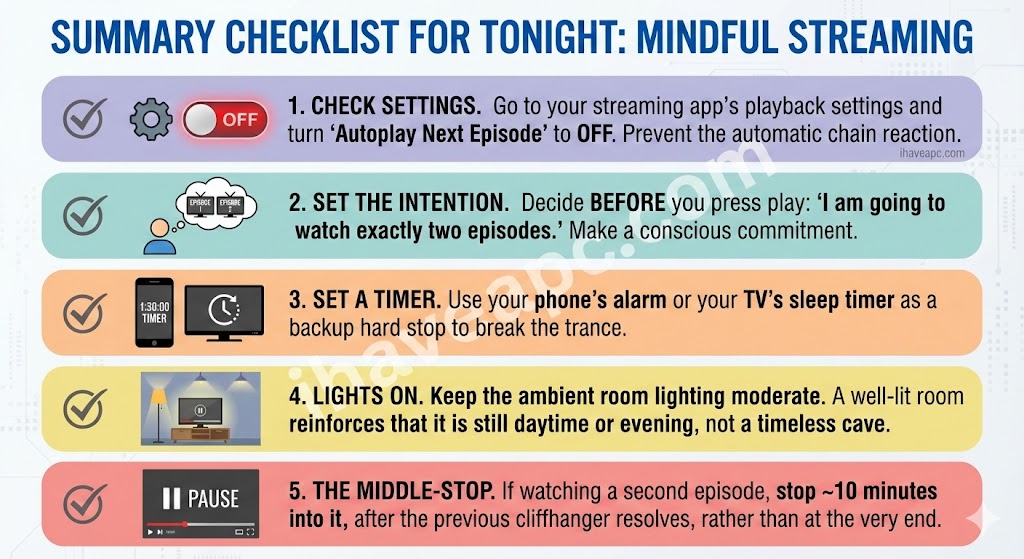
- Check Settings: Go to your streaming app and turn Autoplay OFF.
- Set the Intention: Decide before you press play: “I am going to watch two episodes.”
- Set a Timer: Use your phone or TV timer as a backup.
- Lights On: Keep the ambient lighting moderate.
- The Middle-Stop: If you watch a second episode, try stopping 10 minutes into it, rather than at the end
Conclusion
Streaming services are incredible tools for entertainment and education. They offer us windows into other worlds and allow us to relax after difficult days. The objective of mindful watching isn’t to demonize these platforms, but to change our relationship with them.
By adding a little bit of friction, staying conscious of our physical bodies, and making intentional choices about what and when we watch, we can turn binge-watching from a guilty habit into a rewarding, controlled leisure activity.
Remember: The “Next Episode” button will always be there. But your time is finite. Spend it well.
How Social Media Breeds Low-Grade Anxiety
Which is Better: Digital vs. Offline Journaling