Less is More For Your Digital Wellbeing
Have you ever picked up your smartphone to check a single message, only to look up forty-five minutes later, utterly lost in a sea of viral videos and trending news? You are certainly not alone. We live in an era where our pockets vibrate with the weight of the entire world. Constant information streams flow into our lives every single second of the day.
While staying informed and endlessly connected feels productive on the surface, this relentless barrage of digital data is quietly taking a massive toll on our minds.
In today’s hyper-connected, fast-paced landscape, the old adage rings truer than ever before: less really is more. Embracing a minimal digital diet is no longer just a trendy lifestyle choice for the few; it is a fundamental requirement for protecting our mental well-being, preserving our shrinking attention spans, and reclaiming our humanity in an increasingly noisy world.
The Hidden Cost of Constant Online Connection
Our brains are magnificent, highly evolved organs, but they were simply not designed to process the sheer volume of information we throw at them on a daily basis. Every single notification, breaking news alert, and social media post demands a tiny slice of our cognitive bandwidth. Over time, this constant task-switching heavily fractures our focus.
When we scroll endlessly, we are actively training our brains to crave short, rapid bursts of dopamine. This makes it increasingly difficult to sustain attention on slower, deeper tasks like reading a comprehensive book or having a truly uninterrupted conversation. Furthermore, the content we consume which often consists of heavily curated highlight reels of other people’s lives or heavily sensationalized news stories regularly fuels anxiety, inadequacy, and the dreaded Fear Of Missing Out (FOMO).
According to research published by the American Psychological Association, compulsive media consumption, frequently dubbed “doomscrolling,” is directly linked to substantially increased stress levels and noticeably worsened overall mental health outcomes.
The Cognitive Comeback: Why Less is More
So, what exactly happens when we intentionally turn down the volume? Adopting a minimal digital approach offers profound cognitive benefits that can transform how we operate daily.
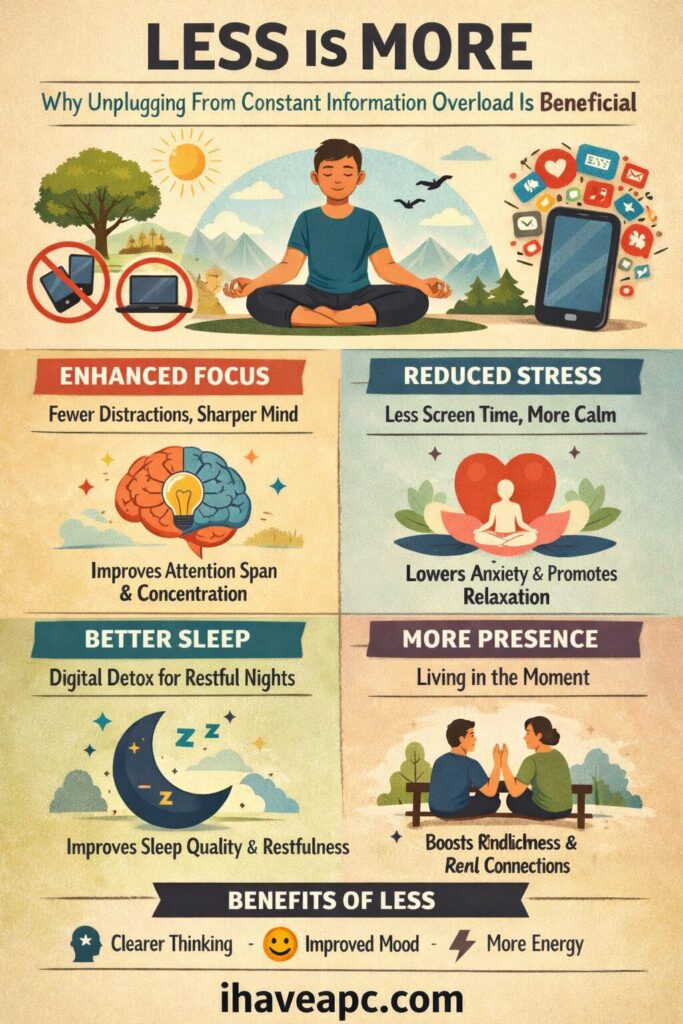
- Restored Attention Span: By firmly limiting the constant interruptions of social media, you allow your brain’s overloaded neural pathways time to heal. You regain the incredible ability to engage in “deep work”—the state of distraction-free concentration that pushes your cognitive capabilities to their absolute limits.
- Improved Memory Retention: Information overload consistently leads to a severe bottleneck in our working memory. When we intentionally consume less, we actually absorb much more. Giving your brain necessary downtime allows it to properly process, consolidate, and store valuable information effectively.
- Enhanced Creativity: Boredom is very often the birthplace of true brilliance. When you are not constantly consuming other people’s creations, your own mind is finally free to wander. This undirected mental state, scientifically known as the default mode network, is absolutely essential for creative problem-solving and generating highly original ideas.
Beyond the Brain: Full-Body Health Benefits
The extensive advantages of digital minimalism extend far beyond basic cognitive function. Our physical health and emotional stability are deeply intertwined with our daily screen habits.
- Better Sleep Hygiene: The artificial blue light emitted by our numerous devices heavily suppresses melatonin production, utterly disrupting our natural circadian rhythms. Moreover, the stimulating nature of late-night scrolling keeps our central nervous system on high alert. Intentionally disconnecting an hour before bed drastically improves sleep quality, naturally leading to significantly better daily mood and higher energy levels.
- Lower Stress and Cortisol: Constant alerts keep our physical bodies trapped in a mild, perpetual state of “fight or flight.” Silencing non-essential notifications actively reduces the chronic release of cortisol, our primary stress hormone. Experts at the Cleveland Clinic strongly note that stepping away from the relentless 24-hour news cycle allows our entire nervous system to return to a healthy baseline state of calm.
Practical Steps Towards Digital Minimalism
Transitioning to a “less is more” mindset does not require you to throw your smartphone into a river and permanently move to the woods. It is primarily about daily intentionality.
- Audit Your Digital Intake: Pay close attention to how different applications make you feel. If scrolling through a particular social platform leaves you feeling unexpectedly drained or anxious, it is definitely time to set strict daily limits or simply hit the delete button.
- Establish Tech-Free Zones: Actively designate specific areas in your home, like the bedroom or the family dining table, where screens are strictly forbidden. This practically helps create solid physical boundaries around your digital consumption habits.
- Schedule Dedicated “Worry Time”: Instead of habitually checking the news ten times a day, allocate exactly twenty minutes in the morning or late afternoon to catch up on current events. Once the timer is up, close the browser immediately.
Reclaiming Your Beautiful Life
In an age of constant information, human attention is our single most valuable currency. Every single time we mindlessly scroll, we are freely giving that precious currency away to massive tech companies designed explicitly to keep us hooked. Choosing less is ultimately a powerful act of modern rebellion and essential self-care.
By fully embracing a minimal digital approach, we actively protect our mental well-being, vastly sharpen our focus, and beautifully create open space for the things that truly matter. Life is happening right now, out in the physical world around you. Put the glowing phone down, carefully take a long deep breath, and really look around.
Then you will undoubtedly find that less truly is more.

The Invisible Burnout: How Digital Life Spikes Cortisol
How White Noise Can Supercharge Your Focus and Digital Wellbeing