The Invisible Burnout: How Digital Life Spikes Cortisol
You wake up. Before your feet even hit the floor, you reach for your phone. A quick check of your email, a scroll through social media, catching up on a few messages—and suddenly, your heart rate is up before you’ve even had your coffee.
If you’re feeling chronically exhausted, perpetually on edge, and struggling to focus, you aren’t alone. We are living in an era of invisible burnout. It’s not necessarily coming from working 80-hour weeks; it’s coming from the glowing rectangles in our pockets.
Our “always-on” digital culture is quietly wreaking havoc on our nervous systems, driving up stress, and keeping our cortisol levels in a constant state of chaos.
Here’s a look at why this happens and, more importantly, how to take your brain back.
The Biology of the Ping: Why Your Brain Thinks It’s Under Attack
To understand why our screens are so exhausting, we have to look at how our brains are wired.
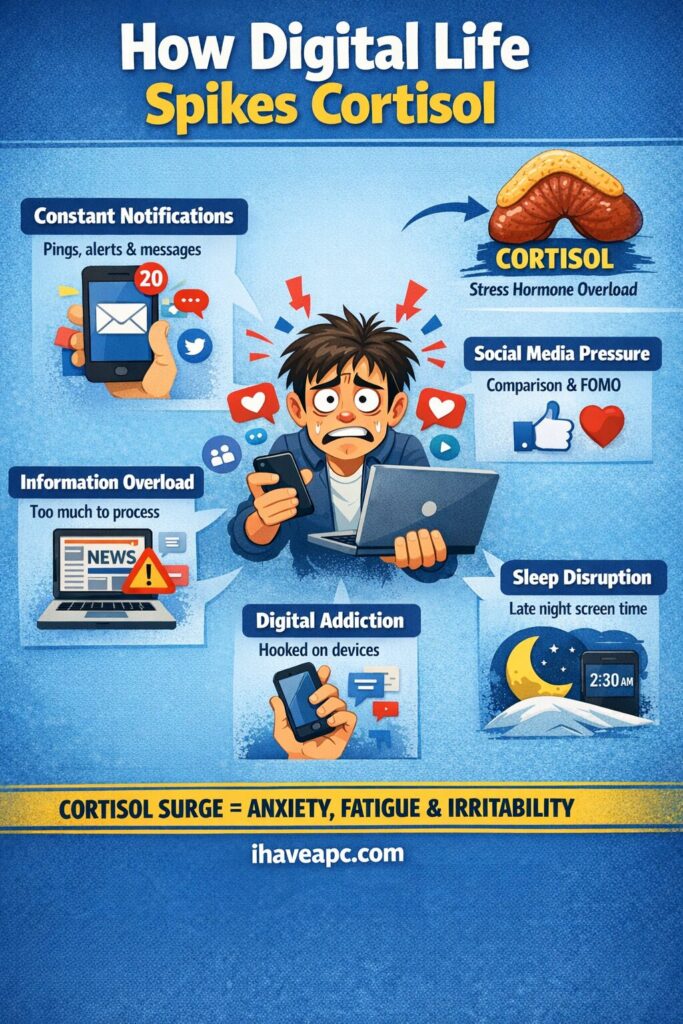
Deep inside your brain is the amygdala, a tiny, almond-shaped structure responsible for your survival. It’s your body’s alarm system. When your phone buzzes with an urgent email or a breaking news alert, your amygdala can’t easily tell the difference between a physical threat in the wild and an aggressive text from your boss.
It just knows something demands your attention right now.
So, it hits the panic button. Your body releases cortisol, the primary stress hormone, preparing you for a “fight-or-flight” response.
- The Problem: After a cortisol spike, it takes the body roughly 20 to 30 minutes to fully recover and return to a baseline state of calm.
- The Reality: We rarely go 20 minutes without another notification, scroll, or distraction. We are trapped in a loop of low-grade, constant panic. Our cortisol never gets a chance to drop.
The Rise of the “Constant Checker”
This relentless need to stay plugged in has birthed a new psychological profile: the “constant checker.“
People who constantly check their emails, texts, and social media accounts report significantly higher levels of stress than those who don’t.
When the lines between “work” and “life” blur into a single, continuous stream of digital input, our brains never get to clock out. The APA found that constant checkers are more likely to feel disconnected from their own families—even when sitting in the same room—and worry deeply about the negative effects of technology on their mental health.
The Dopamine Trap and “Popcorn Brain”
Why do we keep scrolling if it stresses us out? Blame dopamine.
Tech companies have engineered apps to be digital “super-stimuli.” Every like, comment, and endless scroll triggers a hit of dopamine, the brain’s reward chemical. It feels good at that moment, but there’s a hidden cost.
When we flood our brains with cheap dopamine, our receptors become desensitized. We build tolerance. As a result, the real world—reading a book, having a quiet conversation, sitting in silence—starts to feel painfully boring.
Neurologists sometimes call this the “Popcorn Brain” effect. Our minds become so accustomed to the rapid-fire popping of digital stimulation that we lose our capacity for slow, sustained focus. We end up overstimulated, yet entirely unfulfilled.
The Sleep Sabotage
The invisible burnout doesn’t stop when the sun goes down. In fact, that’s when the real damage to your hormonal balance happens.
Every screen emits blue light. To your brain, blue light looks exactly like daylight. When you scroll in bed, your brain misinterprets the light, assuming the sun is still up.
This triggers a hormonal chain reaction:
- Melatonin is suppressed: The hormone you need to signal sleep is blocked.
- Cortisol stays elevated: Because your brain thinks it’s daytime, your stress hormone remains high instead of naturally winding down.
You end up stuck in a state of hyper-alertness exactly when your nervous system is supposed to be recovering.
How to Break the Cycle
You don’t have to throw your phone in a river to fix this. But you do need to create intentional friction between yourself and your digital life.
Here are a few realistic, science-backed ways to lower your cortisol and reclaim your attention:
- Protect Your Mornings: Do not reach for your phone the second you wake up. Let your cortisol rise naturally with morning sunlight and movement, rather than spiking it artificially with emails and news right out of bed.
- Create “Tech-Free” Zones: Establish physical boundaries in your home. For example: no phones at the dinner table, and no screens in the bedroom. Buy an old-school alarm clock so your phone doesn’t have to live on your nightstand.
- Batch-Check Your Apps: Instead of reacting to every ping, turn off non-essential push notifications. Decide to check your email and social media at three specific times a day, rather than 300.
- Use Grayscale Mode: Go into your phone’s accessibility settings and turn the screen to black and white. It immediately makes your phone look like a tool rather than a flashy toy, instantly reducing its dopamine-inducing appeal.
The Bottom Line
Your attention is your most valuable resource, and right now, algorithms are spending it for you. The “invisible burnout” isn’t a personal failure; it’s a biological reaction to an unnatural environment.
By recognizing the physical toll of our always-on digital lives, we can stop blaming ourselves for feeling exhausted and start setting the boundaries our brains desperately need to thrive.

A Realistic Guide to Breaking the SM Doom Scrolling Loop
15 Seconds to Burnout: The Mental Toll of Social Media Reels