15 Seconds to Burnout: The Mental Toll of Social Media Reels
It is incredibly easy to lose an hour (or more) to the endless, hypnotic scroll of TikTok, Instagram Reels, or YouTube Shorts. If you have ever felt mentally exhausted, foggy, or anxious after a scrolling session, your feelings are entirely valid.
These smartphone apps are deliberately engineered using psychological principles to maximize your engagement and keep you hooked.
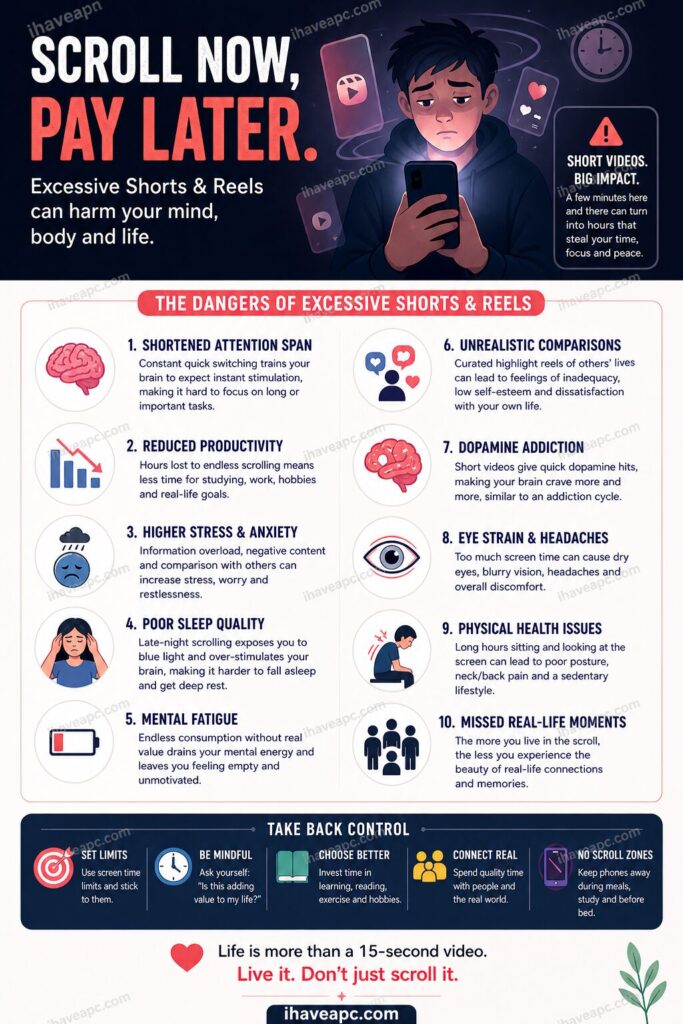
However, understanding the mechanics of how this content affects your brain is the first step toward regaining control.
Let’s look at the science behind the “TikTok brain” and explore realistic ways to protect your digital wellbeing.
The “TikTok Brain”: How Short-Form Content Hacks Attention
The most significant casualty of excessive short-form video consumption is our attention span. Unlike reading a book or watching a full-length documentary, short-form content relies on rapid-fire stimulation.
- Cognitive Overload and Fragmented Focus: The fast-paced nature of these platforms overwhelms the brain’s processing capacity. As you scroll from a comedy skit to a cooking tutorial to a news clip in a matter of seconds, your brain must constantly adjust to new contexts. This continuous context-switching increases cognitive load and fragments sustained attention.
- The “Why Did I Pick Up My Phone?” Effect: Have you ever opened your phone to check a message, watched a few Reels, and suddenly forgotten why you picked up your phone in the first place? Research shows that the constant context-switching required by these feeds actively degrades “prospective memory”—our ability to retain and execute planned intentions.
- Memory Impairment: The damage to our attention span creates a domino effect. Studies demonstrate that addiction to short-form videos directly impairs an individual’s attentional abilities, which in turn acts as a mediator for reduced memory function. If you cannot sustain focus on information, your brain cannot encode it into your memory properly.
The Mental Health Toll of the Endless Scroll
Beyond attention, the structural design of short-form content heavily manipulates our dopamine systems which is the brain’s reward pathway. Every time you swipe and find an entertaining video, you get a micro-hit of dopamine.
- Dopamine Desensitization: Because these hits are so frequent and effortless, your brain can become desensitized. Over time, you require more scrolling to feel the same level of baseline pleasure or motivation, which can leave you feeling numb, demotivated, or agitated when you aren’t using your phone.
- Anxiety and Compulsive Behavior: Compulsive social media use is strongly associated with heightened impulsivity and increased symptoms of anxiety and depression. The algorithm frequently exposes users to idealized lifestyles, appearances, and stress-inducing news, fostering an environment of perpetual social comparison that drains self-esteem.
How to Protect Your Digital Wellbeing
You do not necessarily have to delete your apps entirely to protect your mental state. A realistic approach focuses on setting intentional boundaries and breaking the automatic habit loop.
Introduce “Friction” to Your Scrolling
- Turn off notifications: Don’t let the app tell you when to open it.
- Move the apps: Put TikTok or Instagram in a hidden folder on the last page of your home screen. Making the app harder to find interrupts the muscle memory of mindlessly clicking it.
- Use Grayscale Mode: Switch your phone’s display to black and white. Short-form videos rely heavily on vibrant colors to stimulate your brain; removing the color makes the content significantly less appealing.
- Curate your feed: Ruthlessly unfollow or click “Not Interested” on content that makes you feel anxious, insecure, or annoyed.
- Use built-in app timers: Both iOS and Android have digital wellbeing settings where you can lock yourself out of specific apps after 30 to 60 minutes of daily use.
Practice “Single-Tasking”
Because short-form content fractures your attention, you need to actively practice rebuilding your sustained focus. Dedicate 20 minutes a day to a single, uninterrupted task like reading a physical book, cooking without a podcast, or doing a puzzle.
If you feel the itch to check your phone, acknowledge it, but gently bring your focus back to the task.
The 20-Second Rule
Before you open a short-form video app, pause for 20 seconds. Ask yourself: “Why am I opening this? Am I bored, stressed, or avoiding something?” Often, just identifying the emotional trigger is enough to stop the doomscroll before it starts.
Remember, once you get into a habit of mindfulness when using your devices and see how beneficial it is to your wellbeing, it becomes easier to resist aimless scrolling and using these social media apps.
Best of luck.
Pen, Paper, or Pixels? The Secret to Better Digital Wellbeing

Phone Friction-Maxxing: Why You Should Go Grayscale