Wired but Tired? Reset Your Cortisol in an Always-On World
We live in an era where our smartphones feel less like tools and more like physical extensions of our hands.
While technology keeps us connected, productive, and entertained, there is a hidden biological cost to this 24/7 digital lifestyle: it is stressing us out. If you regularly feel a sense of low-grade anxiety when your phone buzzes or find yourself feeling “wired but tired” at the end of the day, you aren’t alone.
The culprit behind this digital exhaustion is Cortisol.
Here is a look at how constant connectivity impacts our biology and, more importantly, how we can reclaim our peace of mind.
The Cortisol Connection
Cortisol is the body’s primary stress hormone, produced by the adrenal glands.
Evolutionarily, it was designed to be a lifesaver. When early humans faced physical danger like a charging predator, cortisol flooded their system, boosting blood sugar and suppressing non-essential functions to power a “fight-or-flight” response.
The problem? The human brain has not evolved quite as fast as our technology. Your nervous system struggles to differentiate between a life-threatening emergency and a slack notification from your boss at 9:00 PM.
How the Digital World Triggers Stress
When we are constantly online, we subject our bodies to a steady drip of micro-stressors. This chronic exposure disrupts our natural hormone rhythms in several distinct ways:
- The Notification Effect: Every ping, buzz, and red badge is designed to demand immediate attention. Studies have shown that simply receiving a notification can cause an immediate spike in cortisol. When you multiply that by the dozens of alerts the average person receives daily, your stress system never gets a chance to power down.
- Digital Hypervigilance: Even when your phone is sitting quietly on your desk, your brain may be anticipating the next message. This state of constant readiness keeps your baseline cortisol levels abnormally high.
- The Doomscrolling Trap: Mindlessly consuming negative news or comparing your everyday life to heavily curated social media highlights and reels trigger unease and emotional strain, signaling to your body that you are in a hostile environment.
- Blue Light Interference: Cortisol is supposed to peak in the morning to wake you up and gradually drop throughout the day, allowing melatonin to take over at night. The blue light emitted by screens suppresses melatonin and artificially keeps cortisol elevated, destroying your sleep quality.
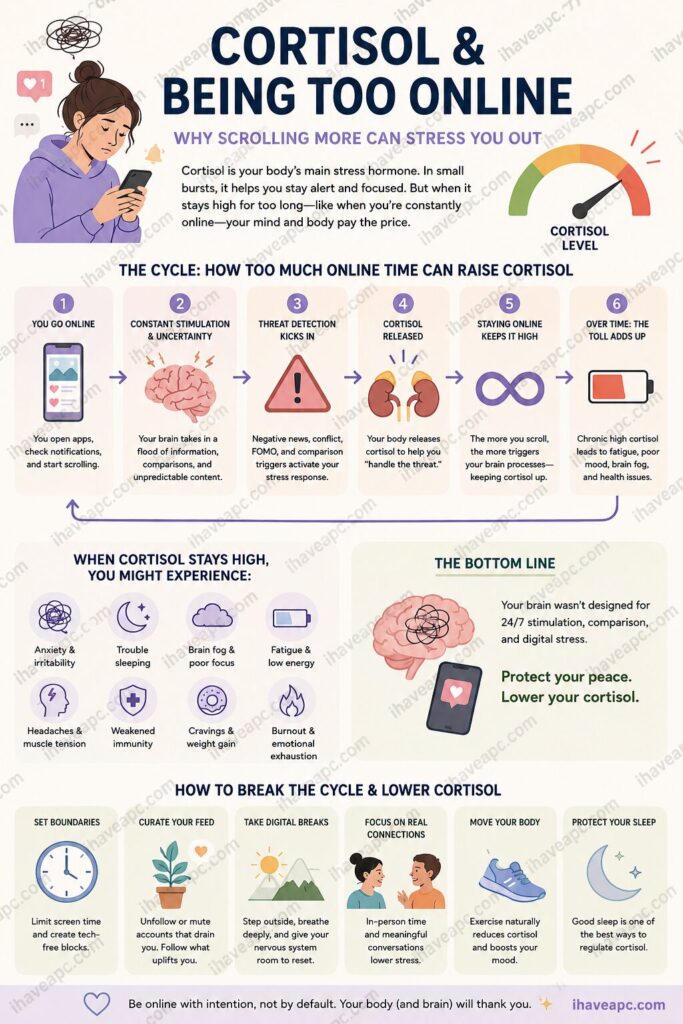
Digital Wellness Tips to Lower Cortisol
You do not need to throw your phone into the ocean and move to a cabin in the woods to find relief. Managing digital stress is about setting intentional boundaries so that technology serves you, rather than the other way around.
Here are actionable ways to lower your cortisol levels in an always-on world:
- Tame the Notification Beast: Go into your settings and ruthlessly audit your alerts. Turn off all non-essential notifications especially for social media, news apps, and promotional emails. Leave alerts on only for direct messages or calls from essential contacts. By removing the unpredictable pings, you stop the continuous micro-spikes in your stress hormones.
- Embrace the “Analog Morning”: Your cortisol naturally spikes in the first 30 to 60 minutes after waking up (a process known as the Cortisol Awakening Response). Reaching for your phone the second you open your eyes floods an already sensitive system with external stressors and cognitive load. Try to spend the first hour of your day completely screen-free. Use this time to stretch, hydrate, read, or simply enjoy your coffee in peace.
- Establish Tech-Free Zones: Create physical boundaries in your home where devices simply aren’t allowed. The most impactful places to start are the dining table and the bedroom. Eating without screens encourages mindful consumption and better digestion, while keeping phones out of the bedroom is the single best thing you can do for your sleep hygiene.
- Practice “Single-Tasking”: Digital multitasking like answering emails while watching a video and checking your phone rapidly drains cognitive resources and increases the release of stress hormones. Train your brain to focus on one digital task at a time. It feels slower at first, but it is vastly more efficient and much gentler on your nervous system.
- Enforce a “Digital Sunset”: Set a hard cutoff time for your devices at least one hour before you intend to sleep. Swap the late-night scrolling for a book, a warm bath, or light stretching. This allows your cortisol levels to naturally drop and your melatonin to rise, paving the way for the deep, restorative sleep your body needs to recover from daily stress.
The Bottom Line
Achieving digital wellness is about building awareness of your digital habits. By recognizing how your devices affect your biology, you can take small, deliberate steps to protect your peace.
So keep it simple.Lowering your cortisol can be as simple as remembering to hit “Do Not Disturb” and taking a deep breath.
Relax.

EMF and Digital Wellness

The Return of the Dial: Why “Dumbphones” Are the Smartest Move